
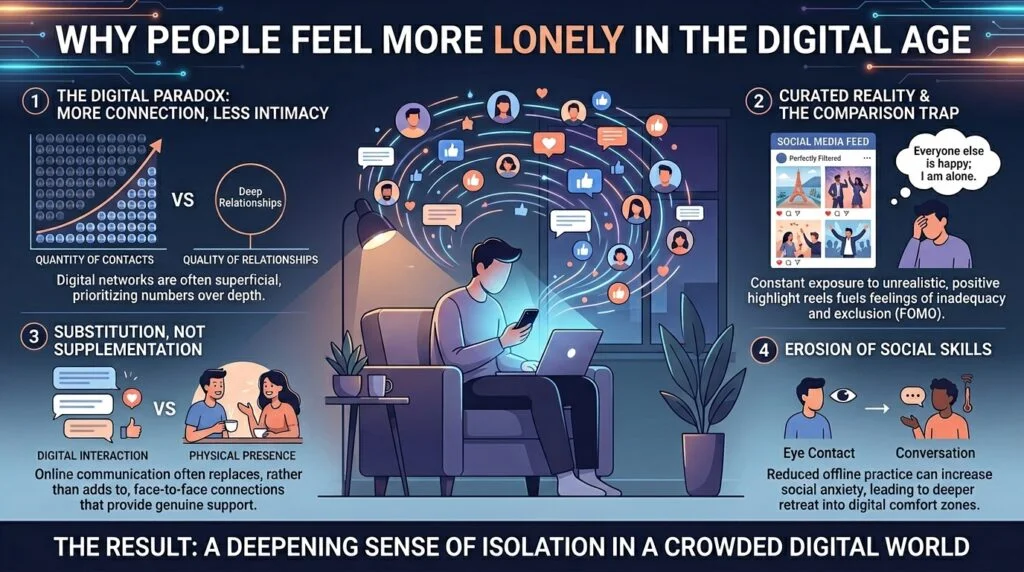
Loneliness in digital age happens when people feel disconnected even while being surrounded by screens and notifications. You can have hundreds of followers and still feel like nobody truly sees you. That feeling is real, and it is more common than most people admit.
Technology was supposed to bring us closer. But for many people, it does the opposite. Scrolling through other people’s highlight reels, comparing yourself, and never having a real conversation it quietly builds a wall around you. If you feel this way, you are not alone, and you do not have to stay silent.
What Is Loneliness in the Digital Age
Loneliness in the digital age is the feeling of emotional disconnection despite being constantly connected online.
It is not about how many people you talk to. It is about whether those conversations feel real. Whether someone truly listens. Whether you feel safe enough to say what you actually feel.
Most online interactions are fast, surface-level, and performative. They fill time. But they do not fill the need to be genuinely understood.
Why Does Technology Make Us Feel More Alone

You compare your life to everyone’s highlight reel
Social media does not show real life. It shows the best 1% of it. When you scroll, your brain quietly compares your everyday reality to everyone else’s best moments. That comparison is exhausting. Over time, it makes you feel like everyone is thriving except you.
Conversations have gotten shallow
Texting, reacting with emojis, sending memes these things are easy. But they are not connection. Real connection needs time, presence, and someone who actually listens. Digital communication strips most of that away.
This is why so many people describe a strange kind of emptiness surrounded by friends online, yet feeling completely unseen. If that sounds familiar, you are not imagining it. It is actually one of the most common emotional experiences today, and we explore it in more depth in our article on why people feel lonely even with friends.
You are always available but never truly present
When you are always reachable, you are never fully anywhere. This creates a strange kind of exhaustion. You talk to people all day but end up feeling like no real conversation happened.
Vulnerability feels risky online
Being honest about how you feel online is scary. People worry about being judged, screenshotted, or misunderstood. So they keep the real feelings hidden. And unexpressed feelings do not go away they just get heavier.
The Emotional Patterns Behind Digital Loneliness

Overthinking and hypervigilance
When you do not feel emotionally safe, your mind starts scanning for signs of rejection read receipts, short replies, slow responses. This kind of overthinking is exhausting and isolating.
Emotional shutdown
After a while, many people stop trying to connect at all. They go quiet online. They cancel plans. They pull away not because they do not want connection, but because they are protecting themselves from more disappointment.
Feeling like a burden
One of the most painful parts of digital loneliness is the thought that your feelings are too much. That people will scroll past your problems the same way they scroll past everything else. So you say you are fine. And you carry it alone.
You do not have to carry this alone. At Hear Inside, you can talk to a real person who listens without judgment, without pressure. Talk to someone today.
Common Myths That Keep People Stuck
Myths worth unlearning
“I should be able to handle this alone.” Loneliness is not a weakness. It is a human need going unmet. Reaching out is not giving up it is taking care of yourself.
“It is not serious enough for therapy.” You do not need to be in crisis to deserve support. Feeling empty, disconnected, or just tired of feeling alone that is enough.
“Everyone else is fine. It is just me.” Almost nobody online shows their loneliness. That does not mean it is not there. You are not uniquely broken. You are human.
What Happens If You Do Not Talk About It
Loneliness that stays unexpressed does not just fade. Research consistently links chronic loneliness to increased anxiety, depression, and physical health problems over time.
More than that when you stop talking about how you feel, you start to lose the habit of trusting people. You build walls without meaning to. And connection becomes harder the longer you avoid it.
Suppressing emotions has real, measurable effects on your mental and physical health. We cover exactly what happens in our guide: What Happens When You Keep Feelings Inside a helpful read if you have been holding things in for a long time.
Naming the feeling is not dramatic. It is the first step toward feeling lighter.
When Should You Talk to Someone

Signs it is time to reach out
You feel like nobody in your life really understands you
You spend a lot of time online but still feel empty afterwards
You are tired of pretending everything is fine
You feel anxious, low, or emotionally flat most days
You want to talk but do not know where to start
You do not have to share everything at once. You can start with just one feeling.
How Hear Inside Can Help
At Hear Inside, you can access anonymous emotional support from real human listeners who are trained to be present with you not to fix you, but to truly hear you.
Sometimes you do not need a full therapy session. You just need someone to pick up. That is exactly what our emotional support call is designed for a real, live conversation with a trained listener whenever the weight of things becomes too much to hold alone.
Whether you are dealing with loneliness, anxiety, relationship difficulties, or just a heaviness you cannot explain, there is a safe, private space waiting for you.
If you and a partner are both struggling with digital disconnection, our couples emotional support can help you rebuild real closeness. And if your child seems withdrawn or overwhelmed, child emotional support gives them the safe space to process what they are feeling.
Everything shared at Hear Inside stays private and confidential. There is no pressure. No judgment. Just a real person, ready to listen.
You do not have to carry this alone
If you feel overwhelmed, disconnected, or just tired of feeling unseen Hear Inside gives you a safe space to talk to a real person who listens and under stands. Talk to Someone Now
Conclusion
Loneliness in the digital age is not caused by a lack of connection, but by the quality of connection. People are surrounded by constant communication, yet much of it is shallow, fragmented, and performative. Scrolling, liking, and messaging create the illusion of interaction, but they rarely replace real emotional presence. Over time, this gap between “being connected” and “feeling understood” creates a deeper sense of isolation, especially when people compare their reality to curated online lives.
The solution is not to reject technology, but to use it more deliberately. Real connection still requires attention, listening, and honesty things that cannot be automated or replaced by algorithms. People who prioritise fewer, deeper relationships, limit passive consumption, and engage in meaningful conversations tend to feel less lonely. The digital world is not the problem on its own, but without conscious use, it quietly replaces real connection with empty interaction.
Frequently Asked Questions
Is it normal to feel lonely even when I use social media every day?
Yes. Digital loneliness is very real. Online interactions are often fast and shallow, which leaves the deeper human need for genuine connection unmet. Many people feel most alone right after scrolling.
What is the difference between being alone and feeling lonely?
Being alone is physical no one is around. Loneliness is emotional you feel unseen or misunderstood even when people are present. You can feel lonely in a crowded room or in the middle of a group chat.
Can talking to someone online actually help with loneliness?
Yes but the quality of the conversation matters. Talking to a trained, empathetic human listener is very different from sending messages into a group chat. At Hear Inside, you speak to a real person who is fully present with you.
Will what I share stay private?
Absolutely. Hear Inside is built on confidentiality. You can even access anonymous emotional support if you are not ready to share your name. What you say stays between you and your listener.
Do I need to be in a serious crisis before I reach out?
Not at all. You deserve support whenever you feel emotionally tired, disconnected, or overwhelmed not just when things reach a breaking point. The earlier you talk, the easier it gets.
How do I start if I do not know what to say?
You can start with exactly that “I do not know where to begin.” That is enough. Your listener at Hear Inside will gently guide the conversation at a pace that feels safe for you.