AI chatbots are increasingly becoming a first line of emotional support for millions of Americans dealing with stress, anxiety, loneliness, and everyday mental health challenges. By leveraging advanced natural language processing (NLP) and machine learning, these tools can hold meaningful, empathetic conversations at any hour of the day no appointment needed, no waiting room, and no judgment. Whether you’re venting about a rough day at work or navigating something heavier like grief, AI chatbots offer an accessible, private space to be heard.
The AI chatbot emotional support capabilities have expanded dramatically in recent years from basic scripted responses to deeply contextual, multi-turn conversations that feel surprisingly human. Platforms like Woebot, Wysa, and Replika are already used by millions in the U.S., and major AI systems like Claude and ChatGPT are being turned to for emotional guidance daily. This article dives into exactly how these systems work, what they can genuinely help with, and where the real boundaries lie.
1. What Does Emotional Support from an AI Chatbot Actually Look Like
Let’s be real for a second. When most people think of therapy or emotional support, they picture a human someone sitting across from you, nodding, asking the right questions. So what happens when it’s a chatbot doing that instead? Surprisingly, for a lot of Americans, it feels more approachable than the real thing.
AI chatbot emotional support capabilities are built on sophisticated language models that can recognize emotional cues in text words like “hopeless,” “exhausted,” or “I just can’t anymore” and respond with carefully crafted, empathetic replies. These systems are trained on vast datasets of human conversation, therapy transcripts, and mental health literature.
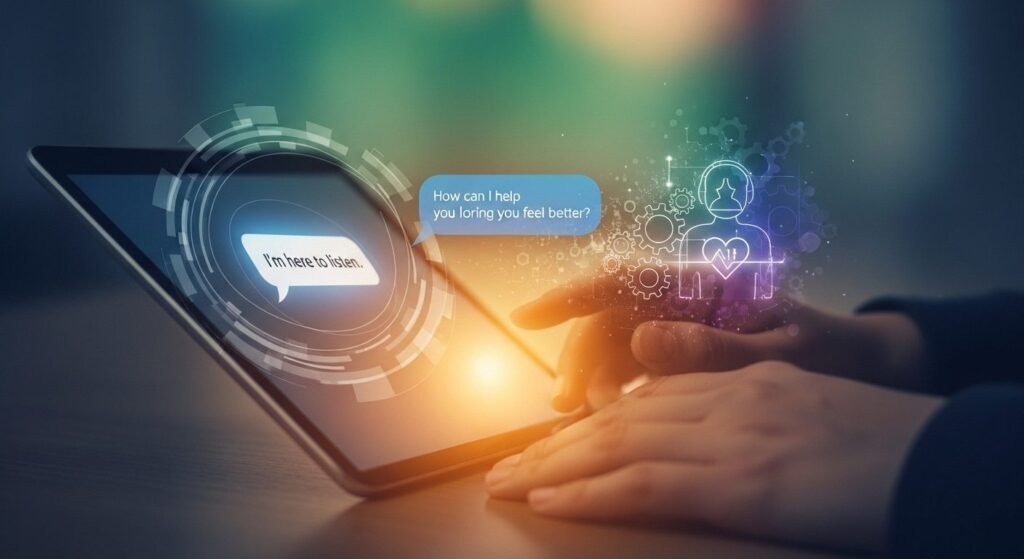
Here’s what a typical emotional support interaction with an AI chatbot looks like:
- You type a message describing how you feel maybe it’s post-breakup sadness or work burnout.
- The chatbot acknowledges your feelings without dismissing them.
- It asks open-ended follow-up questions to better understand your situation.
- It may suggest breathing exercises, journaling prompts, or cognitive reframing techniques.
- It validates your experience without projecting or over-diagnosing.
This kind of interaction isn’t just surface-level feel-good talk. Research published in the Journal of Medical Internet Research found that using Woebot an AI mental health chatbot for just two weeks significantly reduced symptoms of anxiety and depression among college students. That’s a real, measurable outcome.
2. Core AI Chatbot Emotional Support Capabilities
Understanding what these tools can actually do is essential. Below are the key emotional support capabilities that modern AI chatbots bring to the table for U.S. users.
A. Active Listening and Validation
One of the most powerful things any support system can do human or AI is make you feel heard. AI chatbots are now trained to practice active listening, which means they reflect back what you say, ask clarifying questions, and avoid jumping straight to solutions.
Phrases like “That sounds really hard” or “It makes sense you’d feel overwhelmed given everything you’re going through” are not accidental. They’re intentionally crafted to mirror the empathic language real therapists use.
B. Cognitive Behavourial Therapy (CBT) Techniques
Many AI chatbots, especially those purpose-built for mental health like Woebot and Wysa, are grounded in Cognitive Behavourial Therapy principles. CBT is one of the most evidence-based forms of psychotherapy in the world, and it’s highly adaptable to digital formats.
Through CBT-based AI conversations, users can:
- Identify negative thought patterns (e.g., catastrophizing or all-or-nothing thinking)
- Challenge distorted beliefs with guided questioning
- Track mood patterns and triggers over time
- Build healthier coping habits through structured exercises
- Practice mindfulness and grounding techniques
C. 24/7 Availability The True Game-Changer
Here’s one of the most undeniable advantages of AI chatbot emotional support: it never sleeps. Mental health struggles don’t follow a 9-to-5 schedule, and neither do AI chatbots. Whether it’s 3 a.m. on a Tuesday after a panic attack or Sunday afternoon when loneliness hits hardest, these tools are there.
For Americans living in rural areas with limited access to mental health professionals, or those on waiting lists for therapy (which in the U.S. can stretch months), this around-the-clock availability is genuinely life-changing.
D. Emotional Pattern Recognition and Mood Tracking
Advanced AI chatbots can track emotional data across conversations identifying when a user seems to be getting better or showing signs of worsening distress. Apps like Wysa and Woebot prompt daily or weekly mood check-ins, and over time, they build a picture of your emotional landscape.
This data can be empowering for users who want to understand their triggers, and in some platforms, can be optionally shared with a human therapist for collaborative care.
E. Reducing Stigma Around Seeking Help
This one doesn’t get talked about enough. In the U.S., mental health stigma remains a serious barrier to treatment. According to NAMI (National Alliance on Mental Illness), nearly 60% of adults with mental illness did not receive mental health services in the previous year — and stigma is a leading reason why.
AI chatbots offer a stigma-free entry point. You don’t have to explain yourself to a receptionist, worry about your insurance, or feel embarrassed walking into a therapist’s office. You just open an app. That low barrier to entry is bringing emotional support to people who would otherwise go without it.
3. AI Chatbots vs. Human Therapists: An Honest Comparison
This is the big question, isn’t it? Can a chatbot really replace a therapist? Short answer: no. But that’s not the right question. The more useful question is: where do AI chatbots fit in the mental health ecosystem?
Factor | AI Chatbot | Human Therapist |
|---|---|---|
Availability | 24/7, instant response | Scheduled appointments only |
Cost | Free or low-cost ($0–$20/mo) | $100–$300+ per session |
Empathy | Simulated, pattern-based | Genuine human connection |
Crisis Handling | Limited refers to hotlines | Direct intervention possible |
Privacy | Anonymous, no judgment | Confidential but not anonymous |
Personalization | Improves over time via AI | Deep, relationship-based |
Clinical Diagnosis | Not capable | Licensed to diagnose |
The reality is that AI chatbots and human therapists serve different but complementary roles. Think of AI as the first responder available immediately when you need to process emotions and the therapist as the specialist you see for deeper, ongoing clinical work.
For many Americans who can’t afford therapy, can’t get a timely appointment, or aren’t ready to open up to a stranger, an AI chatbot might be the most important tool they have access to right now.
4. What AI Chatbots Are Genuinely Good At (And What They’re Not)
Let’s break it down honestly. AI chatbot emotional support capabilities shine in specific areas and fall short in others.
Where AI Chatbots Excel:
- Immediate support during moments of heightened stress or mild anxiety
- Providing structured coping techniques based on CBT or mindfulness
- Offering a consistent, non-judgmental presence for people who feel isolated
- Helping users articulate and process emotions they struggle to verbalize
- Filling the gap between therapy sessions with daily check-ins
- Serving as a stepping stone for people hesitant to seek human help
Where AI Chatbots Fall Short:
- Handling acute mental health crises or suicidal ideation this requires a human
- Providing clinical diagnosis or formal treatment plans
- Building the deep therapeutic relationship that drives long-term healing
- Navigating complex trauma that requires years of skilled clinical work
- Adapting to nuanced cultural, linguistic, or personal history at a human level
The smartest way to use AI chatbots is as a supplement, not a substitute. They’re tools powerful, accessible, and genuinely helpful but they work best as part of a broader mental health strategy.
5. Benefits and Limitations: A Balanced View
Here’s a clear, side-by-side breakdown of the real benefits and limitations of AI chatbot emotional support for American users:
Benefits of AI Chatbot Support | Limitations to Be Aware Of |
|---|---|
Always available day or night | Cannot diagnose mental illness |
Zero judgment, full anonymity | Lacks genuine human empathy |
Affordable or free access | Not equipped for emergencies |
Reduces stigma around seeking help | Data privacy concerns remain |
Teaches coping skills (CBT-based) | May feel repetitive over time |
Bridges the gap before therapy | Not a replacement for therapy |
6. The Science Behind the Support How AI Understands Emotions
You might be wondering: how does a chatbot actually understand what you’re feeling? It’s a fair question. After all, it’s not a person it can’t see your face or hear your voice crack.
Here’s what’s happening under the hood when you share something emotional with an AI chatbot:
Natural Language Processing (NLP)
NLP allows the AI to parse not just the literal meaning of your words, but their emotional weight. Sentiment analysis algorithms detect whether text is positive, negative, or neutral, and more advanced systems can identify specific emotional states like frustration, sadness, fear, or excitement.
Transformer Based Language Models
Modern AI chatbots like Claude, ChatGPT, and those powering Woebot use large language models (LLMs) trained on billions of text examples. These models learn patterns in how people express emotions and what kinds of responses are helpful making them remarkably good at generating contextually appropriate support.
Reinforcement Learning from Human Feedback (RLHF)
Many AI systems are further refined using human feedback real people rate the quality and helpfulness of AI responses, and the system learns to prioritize what actually feels supportive, empathetic, and useful. This is a big part of why modern AI responses feel so much more natural than chatbots from just five years ago.
7. Real World Impact: Stories from U.S. Users
The data is compelling, but what about real people? Across Reddit, app reviews, and published case studies, Americans are sharing genuine experiences with AI chatbot emotional support:
- A college student in Texas described using Woebot during exam season as “the only thing keeping me sane” when counseling wait times at her university stretched to six weeks.
- A veteran in rural Montana with limited access to VA mental health services said Wysa helped him process daily anxiety between monthly telehealth check-ins.
- A working mom in Chicago used Replika to have a space to “just vent” after her kids went to bed, without burdening her spouse or friends.
These aren’t miraculous recovery stories. They’re stories about people finding a reliable, accessible, stigma-free outlet and that matters enormously in a country where mental health resources remain unevenly distributed.
8. Privacy, Ethics, and What You Should Know Before You Start
Before you open up emotionally to an AI chatbot, it’s worth understanding a few important things:
Your Data and Privacy
When you share personal information with an AI chatbot especially sensitive emotional content you should understand how that data is stored, used, and protected. Look for platforms that:
- Offer end-to-end encryption or local storage of sensitive data
- Have transparent privacy policies that don’t sell user data to third parties
- Allow you to delete your conversation history at any time
- Are HIPAA-compliant if they position themselves as health tools
The Ethical Dimension of AI Emotional Support
There’s an ongoing conversation in the mental health community about the ethics of AI providing emotional support. The core concerns are:
- AI may create false dependency for people who need real clinical help
- Emotional manipulation intentional or not is possible if AI is not designed responsibly
- Users in crisis may rely on AI when they urgently need a human professional
Responsible AI companies are aware of these concerns. The best platforms include crisis detection features that recognize when a user may be in danger and immediately provide emergency resources, hotlines, or prompts to contact a professional.
9. How to Get the Most Out of AI Chatbot Emotional Support
If you’re going to use an AI chatbot for emotional support, here’s how to make it work for you:
- Be honest and specific the more clearly you express what you’re feeling, the better the response
- Use it consistently many platforms get more personalized over time
- Treat it as a tool, not a therapist set realistic expectations from day one
Combine it with other resources journaling, exercise, and human connection all matter - If you’re in crisis, call or text 988 (Suicide and Crisis Lifeline) or reach out to a professional
- Review your data and privacy settings before sharing sensitive personal information
10.Popular AI Chatbot Platforms for Emotional Support
The following table compares the most widely used AI chatbot platforms for emotional support available to U.S. users:
Platform | Availability | Primary Use Case | Key Feature |
|---|---|---|---|
Woebot | 24/7 Mobile App | Anxiety & Depression Support | CBT-based conversations |
Wysa | 24/7 Mobile App | Stress & Mental Wellness | Anonymous emotional coaching |
Replika | 24/7 Mobile/Web | Companionship & Loneliness | Personalized AI companion |
Claude (Anthropic) | 24/7 Web/API | General Emotional Support | Nuanced, empathetic dialogue |
ChatGPT | 24/7 Web/Mobile | Broad Support & Guidance | Wide knowledge + empathy |
11.How HearInside Can Help with Emotional Support via AI Chatbots
Conclusion
AI chatbot emotional support capabilities have come a long way and they’re genuinely helping millions of Americans access a form of mental wellness support that was previously out of reach. They’re available at 3 a.m., they never judge, they don’t require insurance, and they’re getting smarter every year.
But they’re tools not therapists, not doctors, and not a substitute for the deep, irreplaceable value of human connection. The best use of AI chatbots is as part of a broader, intentional approach to mental health: one that includes real relationships, professional support when needed, and self-awareness about your own needs.
If an AI chatbot helps one more person take the first step toward feeling better toward opening up, trying a coping technique, or eventually reaching out to a real professional then it’s doing exactly what it should.
And that’s worth a lot.