
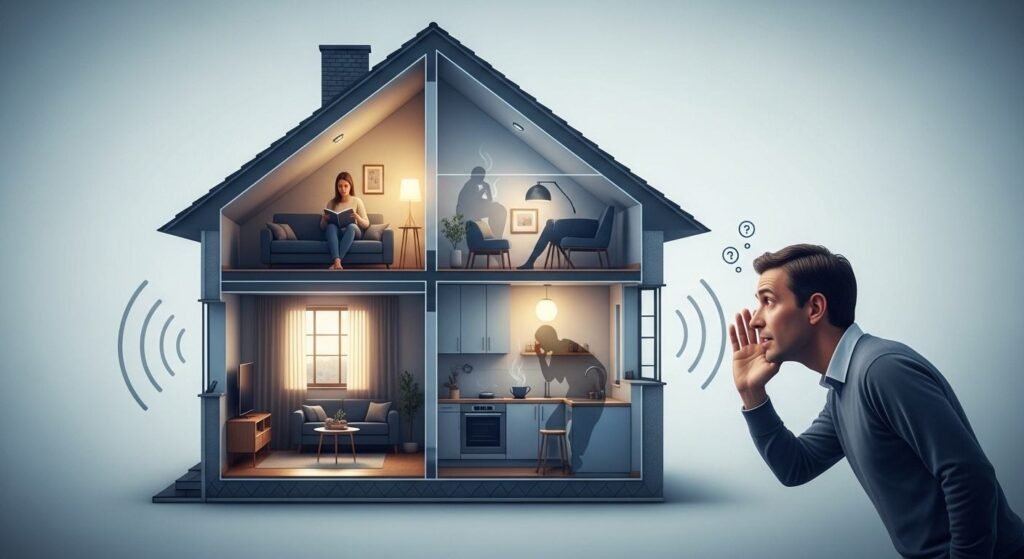
If you’ve ever caught yourself whispering inside your own home because you’re worried your neighbours might be listening, you’re not alone and your concern isn’t paranoia. Millions of Americans live in homes where sound travels far more freely than they realize, whether through thin shared walls, poorly insulated floors, or even gaps around electrical outlets. The question “how can my neighbors hear inside my house” is one of the most searched home privacy topics in the U.S., and for good reason. Understanding why sound escapes your home is the first step toward taking back your privacy.
The truth is, most homes especially apartments, condos, townhouses, and older single-family homes were never fully soundproofed. Builders prioritize cost and speed, not acoustic privacy. From low-frequency sound transmission through concrete to vibrations traveling through shared plumbing pipes, there are at least 9 documented reasons why your conversations, arguments, TV shows, and phone calls may be perfectly audible to the people living next door or above you. This article breaks down every reason with practical, affordable solutions tailored for homeowners and renters across the United States.
Your Home Isn’t as Private as You Think
Picture this: You’re in your living room having a personal conversation, and the next day your neighbor casually references something you said. Or you notice your upstairs neighbor seems to always knock on the wall right when your music gets loud. Sound travels in ways most of us never learned about in school, and modern American housing construction has some serious acoustic weak spots that nobody talks about.
Whether you’re in a Brooklyn apartment, a Houston town home, or a Chicago condo, the physics of sound don’t care about property lines. Sound waves don’t stop at drywall they look for the path of least resistance, and in most American homes, there are plenty of those paths. Let’s unpack all nine of them.
9 Surprising Reasons Your Neighbours Can Hear Inside Your House
1. Thin or Poorly Insulated Shared Walls
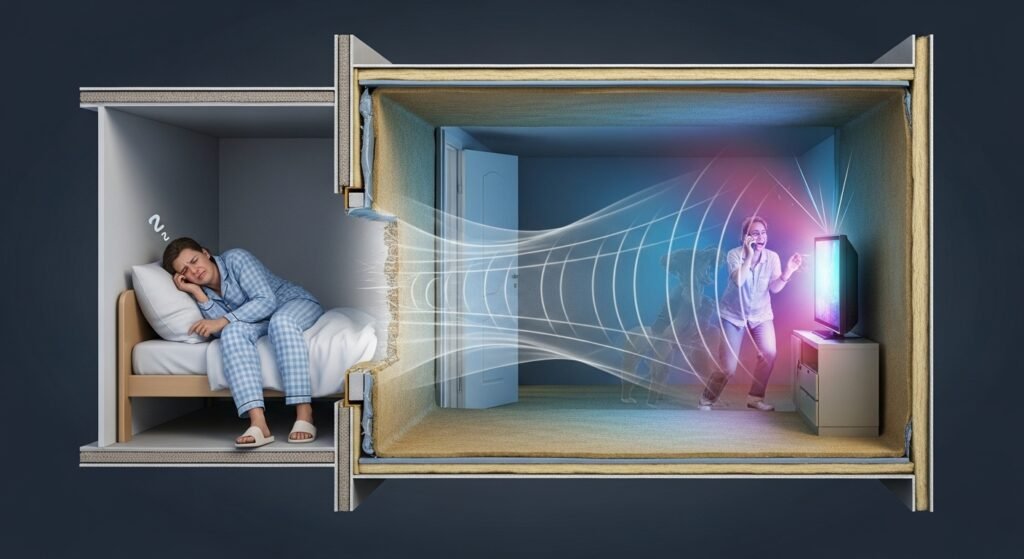
This is the number one culprit in apartments and condos. The standard drywall partition used in American residential construction typically two layers of 1/2-inch drywall with minimal insulation does very little to block sound. The Sound Transmission Class (STC) rating of a basic drywall wall is around 33–35, meaning normal speech can be heard clearly. Building codes in most U.S. states only require an STC rating of 45 for party walls between units.
Solutions: Add mass-loaded vinyl (MLV) behind drywall – Install resilient channel clips to decouple drywall from studs – Use acoustic insulation such as Rockwool Safe ‘n’ Sound between wall cavities
2. Gaps Around Electrical Outlets and Switch Plates
This one shocks most homeowners. Electrical boxes on shared walls are often installed back-to-back, creating a direct sound tunnel straight through the wall. Even when they’re offset, the gaps around the outlet box are rarely sealed, leaving open air channels for sound to travel freely.
Solutions: Install outlet gasket seals (foam pads that fit behind outlet covers) – Use acoustic putty pads behind electrical boxes on shared walls – Never install back-to-back outlets on party walls during renovation
3. Shared HVAC Ductwork and Ventilation Systems
In multi-unit buildings across the U.S., HVAC ducts often run through shared walls or connect adjacent units. Sound waves travel through air, and if your ductwork connects to your neighbours system, your conversations can literally travel through the vents. This is especially common in older New York and Chicago-style apartment buildings.
Solutions: Install duct silencers or sound baffles in the ductwork – Add duct liner insulation inside exposed ducts – Have an HVAC professional evaluate your system for acoustic leaks
4. Impact Noise Through Floors and Ceilings
Impact noise is a different animal from airborne noise. When your upstairs neighbour walks, drops something, or drags furniture, those vibrations travel directly through the building’s structural framing into your ceiling and vice versa. This is why you can often feel your neighbours bass or footsteps more than hear them.
Solutions: Add area rugs with thick underlays on your floors – Install floating floor systems (floors decoupled from the subfloor) – Use resilient ceiling mounts to isolate your ceiling drywall
5. Hollow Core Interior Doors Facing Shared Hallways
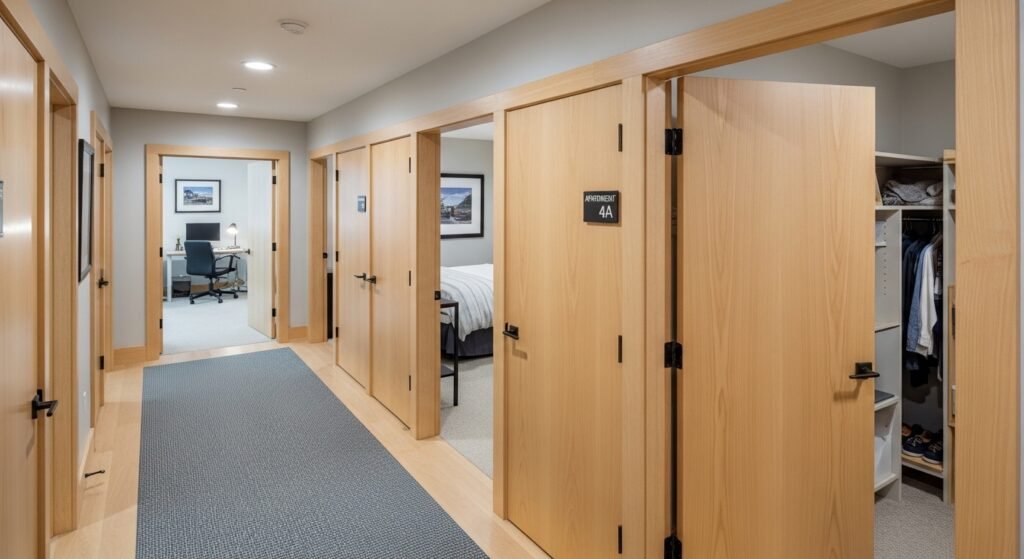
Most American apartments use hollow-core doors, which offer almost zero sound resistance. If your front door opens to a shared hallway and your neighbours door is nearby, conversations in your entryway can easily travel into the hallway and be heard through their door too.
Solutions: Replace hollow-core doors with solid-core doors (STC ~28–35 vs. ~15–20) – Add door sweeps and acoustic weather stripping to seal door gaps Install door seals on all four edges of shared entry doors
6. Shared Plumbing Walls
Plumbing pipes run through shared walls in many U.S. town homes and condos. Water rushing through pipes, toilet flushes, and even vibrations from a running dishwasher can transmit sound through the wall. Additionally, the studs supporting these pipes are firmly attached to the building structure, making them excellent sound conductors.
Solutions: Wrap supply and drain pipes with pipe insulation foam or mass-loaded vinyl – Request that a plumber add pipe isolation hangers to reduce structural vibration – Add acoustic panels near the wet wall on your side
7. Concrete or Masonry Construction With No Acoustic Treatment
Ironically, harder construction materials like concrete and brick common in East Coast row houses and converted industrial lofts can actually transmit low-frequency sound better than softer materials. Bass frequencies (like those from a subwoofer or HVAC motor) travel extremely efficiently through dense, rigid materials.
Solutions: Use decoupled wall systems (don’t let your bookshelves or furniture touch shared walls) Add bass traps in room corners to absorb low-frequency energy – Install thick acoustic panels or hanging fabric art on shared walls
8. Windows Facing the Same Side or Courtyard
If you and your neighbour both have windows facing the same courtyard, alley, or side yard, sound can travel out your window and right back in through theirs especially at night when ambient noise is low. This is extremely common in urban neighbourhoods across cities like San Francisco, Boston, and New York.
Solutions: Use double or triple-pane windows for better STC ratings – Add heavy, floor-to-ceiling blackout curtains or acoustic drapes – Install window inserts (secondary glazing) for a fraction of replacement window cost
9. Structural Flanking Paths Through the Building Frame
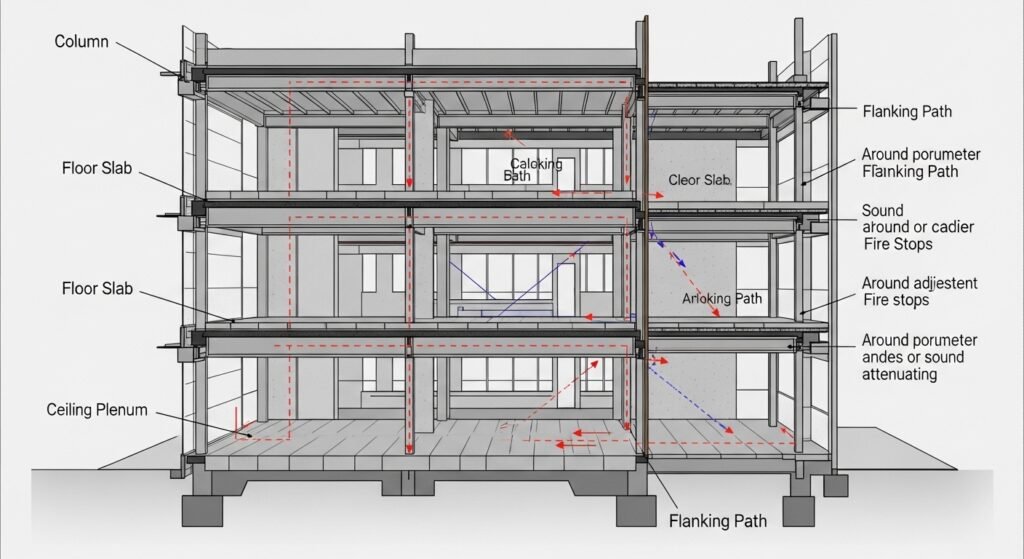
This is the sneakiest one. Even if a wall itself is perfectly soundproofed, sound can bypass it entirely by traveling through the building’s structure through beams, joists, concrete slabs, and steel columns. This is called “flanking transmission” and it’s why professional recording studios spend as much money on structural isolation as on wall insulation. In a shared building, flanking paths are almost impossible to eliminate without major structural work.
Solutions: Use floating floor and ceiling systems to break flanking paths – Decouple your walls from the floor and ceiling using resilient mounts For renters: strategic placement of heavy bookshelves and furniture along shared walls helps absorb flanking vibrations
Sound Transmission Class (STC) Rating Guide
Understanding STC ratings helps you make smarter decisions about soundproofing investments. Here’s what different STC scores mean in practical terms for your home:
STC Rating | What You Can Hear | Typical Construction Type |
|---|---|---|
25 – 30 | Normal speech heard clearly and easily | Basic single drywall, no insulation |
33 – 38 | Loud speech audible, normal speech barely heard | Standard double drywall, minimal insulation |
40 – 45 | Loud speech heard as murmur; most speech private | Double drywall + insulation (U.S. building code minimum for party walls) |
50 – 55 | Very loud sounds faintly heard | Double drywall + resilient channel + acoustic insulation |
60+ | Near-complete sound privacy | Professional soundproofing or recording studio construction |
Comparison of DIY Soundproofing Solutions
Not all soundproofing upgrades are created equal. Here’s how the most popular DIY solutions stack up for effectiveness, cost, and ease of installation especially for renters and homeowners in the U.S.:
Solution | Effectiveness | Approx. Cost (Per Room) | Renter-Friendly? | Best For |
|---|---|---|---|---|
Acoustic panels / foam tiles | Moderate (reduces echo, some sound absorption) | $50 – $200 | Yes | Home offices, bedrooms |
Mass-loaded vinyl (MLV) on walls | High (adds mass, blocks airborne sound) | $150 – $500 | Partially | Party walls, shared walls |
Heavy curtains / acoustic drapes | Moderate (absorbs sound near windows) | $80 – $300 | Yes | Windows, open doorways |
Door sweeps + weather stripping | High for gap sealing | $20 – $60 | Yes | Entry doors, hollow doors |
Outlet gasket seals | High for their low cost | $10 – $30 | Yes | Electrical outlets on shared walls |
Resilient channel + drywall | Very High (structural decoupling) | $500 – $2,000+ | No (renovation needed) | Full wall renovation |
Floating floor systems | Very High for impact noise | $1,000 – $5,000+ | No | Floors in condos/townhomes |
Window inserts (secondary glazing) | High (adds second pane without replacing windows) | $200 – $800 per window | Yes (removable) | Apartment windows |
When to Suspect Something More Than Architecture
Sometimes, the reason your neighbours seem to know too much isn’t because of sound traveling through walls it’s because of deliberate eavesdropping technology. While this is far less common, it’s worth knowing about if you have specific concerns about your privacy:
- Baby monitors or listening devices placed near shared walls can pick up sound from adjacent units
- Parabolic microphones can capture conversations through glass windows from outside
- Smart home devices (Alexa, Google Home) placed near windows or thin walls may transmit ambient sound
If you suspect deliberate surveillance, document your concerns and consult local law enforcement. In the United States, using a listening device to record someone in their home without consent is illegal under the Federal Wiretap Act and most state wiretapping laws.
Room by Room Sound Privacy Checklist
Use this quick checklist to identify and fix the most common sound leaks in your home:
Living Room: Add area rugs and upholstered furniture to absorb sound – Place large bookshelves against shared walls (adds mass) – Hang thick curtains on windows facing neighbours
Bedroom: Use a white noise machine or fan for masking ambient sound – Seal gaps under doors with door sweeps – Replace hollow-core closet doors with solid-core if they face shared walls
Home Office: Acoustic panels behind your desk reduce echo and absorb outgoing sound – A door seal kit on your office door keeps conversations inside. Avoid placing desks against shared walls
Bathroom / Kitchen: Wrap visible pipes with foam insulation. Check for gaps around pipe penetrations in walls and seal with acoustic caulk – Install exhaust fan silencers if ductwork runs to shared spaces
How to Talk to Your Neighbour About Sound Issues
Before you spend a single dollar on soundproofing, it’s worth having a direct but friendly conversation with your neighbour. In the U.S., neighbour noise disputes are one of the top causes of apartment lease terminations and homeowner association complaints. Here’s how to handle it:
- Be specific, not accusatory. Say “I’ve noticed I can hear conversations through our shared wall” rather than “You’re too loud.”
- Propose mutual solutions. Offer to add rugs or acoustic panels on your side in exchange for them doing the same.
- Involve your landlord or HOA if direct conversation doesn’t work. Most U.S. lease agreements include quiet enjoyment clauses that can be enforced.
- Document everything in writing if the issue escalates, especially in renter situations.
Final Thoughts
Sound privacy is a real quality-of-life issue that millions of Americans deal with every single day. Whether you’re working from home, raising kids, or just want to have a private phone call without the whole building knowing your business, the good news is that most of the nine reasons listed above have practical, affordable fixes. Start with the low-cost wins outlet gaskets, door sweeps, heavy curtains and work your way up to bigger investments like resilient channels and floating floors if needed. Your home should feel like your sanctuary, and with the right approach, it absolutely can.