

You are surrounded by friends, your phone buzzes with messages, and your social calendar is packed yet something feels deeply, quietly wrong. If that sounds familiar, you’re not alone. Millions of Americans experience what psychologists call ‘social loneliness amid connection the painful paradox of feeling invisible and emotionally empty even in a room full of people who supposedly care about you. It’s one of the most misunderstood emotional experiences of our time, and it’s getting worse.
Research from Harvard, the American Psychological Association, and the U.S. Surgeon General’s office confirms that loneliness has reached epidemic levels in the United States and it’s not simply about how many friends you have. It’s about the quality of those connections. Feeling lonely with friends happens when your relationships stay surface level, when you can’t be your true self, or when the people around you don’t truly ‘see’ you. This article breaks down exactly why this happens, the real science behind it, and most importantly what you can do about it starting today.
The Loneliness Paradox: When Connection Is not Enough
So how is it even possible to feel lonely with friends. The answer starts with understanding what loneliness actually is.
Loneliness isn’t about being physically alone. According to the American Psychological Association, loneliness is the subjective feeling that your social needs are not being met in quality, not just quantity. You can be surrounded by people and still feel unseen, unknown, and emotionally starving.
Think about that word: quality. You can have 200 followers, a standing brunch crew, and a work friend who makes you laugh every day and still go home feeling like nobody really knows you. That gap between presence and genuine connection is the loneliness paradox. And for millions of Americans, it’s the default setting of modern life.
The Different Types of Loneliness
Before we go further, it’s important to understand that not all loneliness looks or feels the same. Here’s a table that breaks it down clearly:
| Type of Loneliness | What People Think It Means | What’s Actually Happening |
| Emotional Loneliness | You need more friends | You lack deep emotional bonds |
| Social Loneliness | You’re antisocial or shy | Your social needs aren’t being met |
| Existential Loneliness | You’re being dramatic | You feel a lack of purpose or meaning |
| Relational Loneliness | Just hang out with friends more | Your friendships feel one-sided or fake |
Most people only think about the first type I just need more friends.’ But the most painful and most common type for people who already have friends is relational loneliness: you have people in your life, but those relationships feel hollow, one-sided, or emotionally unsafe. Recognizing which type you’re dealing with is step one. People experiencing relational loneliness often reach a point where they simply want someone to listen without judgment. In situations like this, many people look for places where they can talk to someone when feeling lonely.
The Real Reasons You Feel Lonely Around Friends
Understanding the ‘why’ is where things get honest. Here are the most common and most overlooked reasons people feel lonely even with a full social circle:
1. Your Friendships Are Permanently Stuck at the Surface

American social culture is masterful at small talk and deeply uncomfortable with emotional depth. We’ve been trained since childhood to ask ‘How are you?’ and expect ‘Good, you?’ Nobody actually answers that question honestly. When friendships stay on the surface level for too long, emotional needs remain unmet. Research also shows how emotional support improves mental health by reducing stress and strengthening relationships.
When your friendships never move beyond sports, TV shows, weekend plans, and work complaints, you spend a lot of time with people without ever truly knowing them or being known by them. It’s like eating food with no nutritional value. You feel full for an hour, then you’re starving again.
2. You are Wearing a Social Mask 24/7
This one hits hard and is incredibly common in the United States, where there’s enormous cultural pressure to appear happy, successful, and ‘totally fine.’ Many people become so skilled at performing their social role the funny one, the strong one, the together one that they lose touch with who they actually are underneath. Opening up about your emotions may feel uncomfortable at first, but many people discover the benefits of talking to someone
When nobody in your friend group knows the real version of you your fears, your grief, your confusion, your weird thoughts at 2 AM then every interaction reinforces the loneliness instead of relieving it. You’re there, but you’re not really there.
3. You Need Depth; Your Circle Needs Breadth

Some people are wired to need fewer, deeper connections. Others thrive on larger social networks with lighter interaction. Neither is wrong. But if you’re someone who needs to feel truly known, and your social circle is built for fun and frequency rather than depth and vulnerability, you’re going to feel lonely no matter how many people show up. For people who struggle to share their emotions openly with friends, exploring anonymous emotional support guide can sometimes feel like a safer first step.
4. Unhealed Emotional Wounds Keep People at Arms Length
Past betrayal, abandonment, rejection, or emotional trauma can make genuine intimacy feel genuinely dangerous. Many people unconsciously keep even their closest friends at a safe distance and then wonder why they feel alone. The emotional wall protects you, but it also traps you inside it.
5. You are Going Through Something Nobody Around You Understands
Grief. Chronic illness. Mental health struggles. Financial devastation. Career failure. Caring for a sick parent. When you’re carrying something heavy and the people around you can’t relate or don’t know how to show up the silence around your real life creates a kind of isolation that’s almost worse than being physically alone. You’re present, but the most important parts of you have nowhere to go.
Warning Signs You Feel Lonely Even With Friends
How do you know if what you’re experiencing is situational or something deeper. Run through this checklist honestly:
| Warning Sign | How It Shows Up | What It Actually Means |
| Surface-level conversations | Only talk about work, sports, TV | No emotional depth exists in the friendship |
| Feeling unseen or unheard | Friends forget or dismiss what you share | Your voice doesn’t feel valued |
| Performing happiness | Smiling and laughing but feeling empty | You’re wearing a social mask |
| Post-hangout emptiness | You feel worse after spending time together | The connection isn’t filling your emotional tank |
| Fear of being real | You hold back your true thoughts and feelings | Trust and vulnerability are missing |
If three or more of those resonate with you, this isn’t just an off week. Your social life may look full from the outside while feeling hollow from the inside and that gap is worth paying attention to.
What the Science Says About This Kind of Loneliness
This isn’t just a feelings problem. There’s serious, well-funded science behind this and it’s been sounding the alarm for years.
- A 2023 advisory from the U.S. Surgeon General officially declared loneliness a public health epidemic, stating it carries health risks comparable to smoking 15 cigarettes per day.
- The Harvard Study of Adult Development one of the longest-running studies on human happiness in history found that the quality of our close relationships, not wealth or fame or status, is the single biggest predictor of long-term health and happiness.
- A 2023 Gallup survey found that 1 in 5 Americans reported feeling lonely ‘a lot’ of the previous day even among those who described themselves as having close friends.
- Neuroscience research shows that loneliness activates the brain’s threat-detection system the same alarm that fires when you’re in physical danger. Your brain treats social isolation like a life-threatening emergency because, evolutionarily, it was.
- Chronic loneliness elevates cortisol, weakens immune function, disrupts sleep, and has been linked to significantly higher risk of heart disease, depression, cognitive decline, and early death.
This is not a soft problem. It’s a physical health crisis wearing an emotional disguise.
How Social Media Is Making Your Loneliness Worse
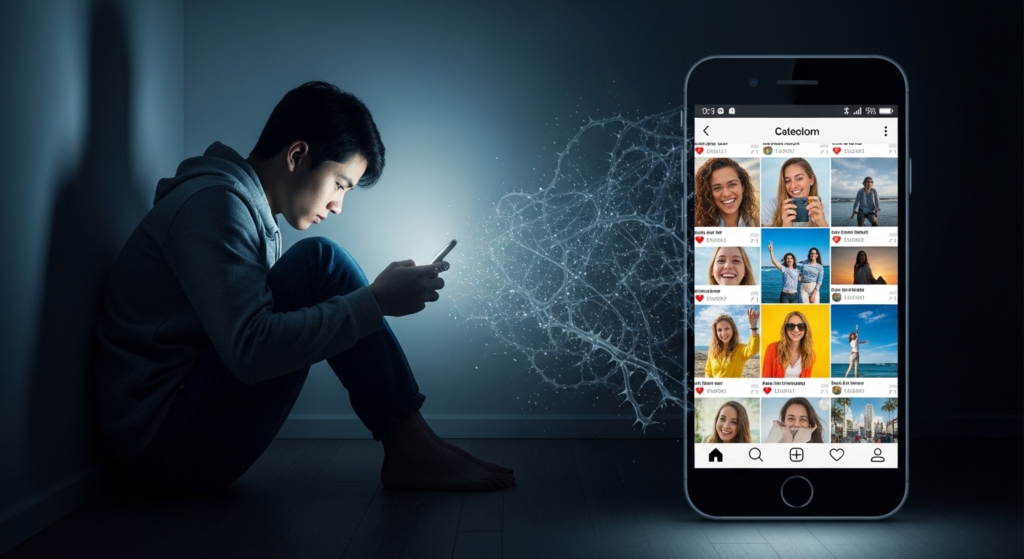
Here’s one of the cruelest ironies of modern life: we now have more tools to connect than at any point in human history, and we are lonelier than at any point in human history.
Social media creates an illusion of intimacy. Liking someone’s photo, watching their stories, reacting to their posts it all feels like staying connected. But it’s a substitute for real connection, not the thing itself. It’s like looking at pictures of food when you’re hungry. It keeps you occupied, but it doesn’t feed you.
Worse, social media creates relentless comparison. When your feed shows everyone else’s highlight reel — their perfect relationships, their promotions, their European vacations it amplifies the feeling that something is uniquely broken about you. That you’re the only one who feels this empty inside. You’re not. You’re just the only one posting about it honestly.
Why This Is Especially Painful in America Right Now
The United States has specific cultural conditions that make this particular flavor of loneliness especially sharp and especially hard to escape:
- Hyper-individualism: American culture glorifies independence and self-sufficiency in ways that can make needing others feel like weakness. Asking for emotional support gets treated like a character flaw.
- Geographic mobility: Americans move constantly for school, for work, for opportunity. Friend groups fragment and reform. Deep, long-term friendships that survive distance are rare and hard to maintain.
- The work culture: Americans work more hours than citizens of nearly any other developed nation. That leaves less time and far less emotional energy for the kind of slow, attentive, present friendship-building that creates real depth.
- Post-pandemic social damage: COVID-19 didn’t just disrupt social habits temporarily. For many Americans, it permanently altered their comfort with social settings, and old friendships that went dormant during lockdowns were never rebuilt.
- Mental health stigma: Despite real cultural progress, many Americans particularly men are still conditioned not to talk about emotional pain. The result is that even the closest friendships stay emotionally sealed.
What You Can Actually Do: A Real Action Plan
This is the section most loneliness articles skip, because it requires more courage than ‘just get out more.’ Real solutions to this kind of loneliness take honesty, patience, and a willingness to change how you show up in relationships.
Go Vulnerable First
Someone has to go first. If you want deeper friendships, you have to be willing to drop the mask before anyone else does. Share something real something you’re scared of, something you’re struggling with, something you’ve never said out loud. You will lose some people. They’ll get uncomfortable and pull back. But you will find your people the ones who lean in. Those are the friendships that will actually help.
Audit Your Existing Friendships Honestly
Not every friendship is meant to go deep, and that’s okay. But be honest with yourself: which relationships leave you feeling more like yourself, and which ones leave you feeling more alone. You don’t have to cut people off but you can be intentional about where you invest your limited time and emotional energy.
Seek Out Interest Based Communities
Some of the most profound, unexpected friendships form around shared passions and values not just shared geography or circumstance. Running clubs, book clubs, volunteer organizations, creative workshops, faith communities, support groups these create contexts for repeated, meaningful interaction with people who are there for a reason that matters to you.
Get Professional Support If You Need It
There is no shame in working with a therapist to understand why genuine connection feels so difficult. Often, loneliness within friendships is rooted in patterns from early life insecure attachment, fear of rejection, chronic people-pleasing, emotional avoidance that therapy can genuinely transform. If this has been a long-standing pattern, that’s worth exploring.
Your Roadmap: From Lonely to Connected
Here’s a practical, realistic timeline to start breaking the cycle one step at a time:
| Timeline | Action Step | Expected Outcome |
| This Week | Have one honest, vulnerable conversation with a close friend | Break the surface-level pattern |
| This Month | Join one new group aligned with your real interests | Find people who share your values |
| 3 Months In | Identify which friendships drain vs. recharge you | Invest your energy where it matters most |
| 6 Months In | Consider therapy if loneliness patterns persist | Address deeper emotional and attachment patterns |
The Honest Truth Nobody Wants to Say Out Loud

Sometimes, feeling lonely with friends is a signal that you’ve outgrown certain relationships. That you’ve changed and the friendships haven’t evolved with you. That’s painful genuinely painful but it’s also normal and necessary.
And sometimes it’s a signal about your own patterns. That you’ve been playing it emotionally safe for so long that even your closest friends don’t actually know you. That’s not a life sentence. It’s fixable. But it requires you to be braver than you’ve been comfortable being.
The loneliness you feel isn’t evidence that something is fundamentally, permanently wrong with you. It’s evidence that you have a deep, legitimate human need for real connection the kind where you can say ‘I’m not okay’ and someone stays in the room with you. Doesn’t try to fix it. Just stays.
That kind of connection exists. It might just require you to ask for it differently than you’ve been asking.
Conclusion
Feeling lonely with friends is one of the quietest, most misunderstood forms of pain that exists. It doesn’t show up on medical charts. It doesn’t get sympathy cards or casseroles. But it is real, it is widespread, and it matters for your mental health, your physical health, and your ability to build a life that actually feels like yours.
The answer isn’t more friends. It’s better connections or deeper versions of the friendships you already have. It’s conversations that go somewhere real. It’s allowing at least one person in your life to see who you actually are underneath the performance.
You were built for real connection. Not the kind that fills your calendar, but the kind that fills your chest where you leave a conversation feeling more like yourself, not less.